
 STAMTEC IN 60 SECONDS:
STAMPING PRESS BLOG

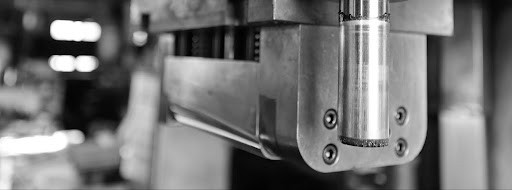
A metal bracket, an appliance panel, and a car door seem an unlikely trio, but they have at least one thing in common: they're all products of a stamping press. What is a stamping press and how does it work? This machine applies controlled force to a sheet or coil of metal, pressing it against a shaped tool, called a die, to cut, bend, or form it into a finished part. The press supplies the muscle. The die supplies the shape. Together, they turn flat stock into precise components at high volume.
In this guide, we'll cover the fundamentals: what a metal stamping press does, the mechanics behind it, the press cycle, the main types Stamtec builds, the industries that depend on them, and how to choose the press that fits your work.
A metal stamping press converts stored energy into a downward force that drives an upper tool into a lower tool. The workpiece sits between them. When the two halves close, the metal is either sheared (cut) or formed (bent and shaped), depending on how the die is built. A single stroke can punch holes, trim edges, coin a surface, and form a contour all at once if the tooling is designed for it.
Force is the whole story. Presses are rated by tonnage, which is the maximum force the machine can deliver at the bottom of its stroke. A small part in thin material might need only 25 tons, while a large structural component in thick, high-strength steel calls for several hundred tons or more. Matching tonnage to the job is one of the first decisions any engineer makes, because an undersized press will struggle and an oversized one wastes capital.
To understand how a stamping press works, it helps to know the main parts:
The three main stamping press types Stamtec manufactures each solve a different kind of problem. Choosing among them starts with the material, the part geometry, and the level of control the process demands.
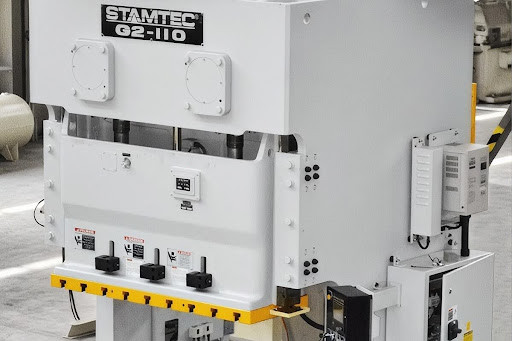
Using a flywheel to store energy and a crankshaft or eccentric gear to convert rotation into the slide's stroke, a mechanical press is fast, reliable, and cost-effective, making it the workhorse of high-volume blanking and forming. Stamtec stocks mechanical presses from 25 to 600 tons and builds custom models up to 3,000 tons, in gap-frame and straight-side designs. Gap-frame models give you open access on three sides for easy die changes and part removal, while straight-side models handle heavier, off-center loads with less deflection.
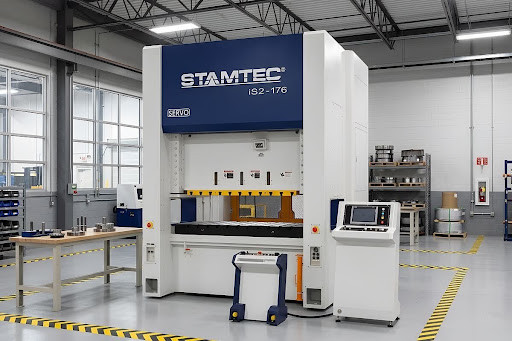
A servo press replaces the flywheel and clutch with a high-torque, low-RPM servo motor. That change gives the operator full programmable control over slide position, speed, and dwell, along with full working energy even at slow speeds. If a job needs a slow, controlled forming motion for deep draws or hard-to-form alloys, then wants to speed back up for the return, a servo press can do both without a tooling change, which is where its flexibility translates into greater productivity and profitability.
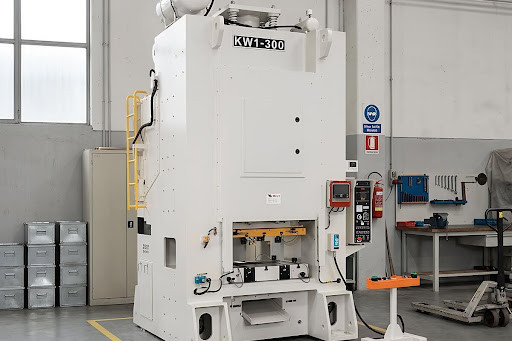
These beasts are built for the heaviest work, shaping billet or bar stock into dense, high-strength parts like automotive shafts, steering components, gears, bearing housings, and connecting rods. Stamtec offers warm-hot forging presses for material formed at elevated temperature and cold forging presses for room-temperature work, spanning 220 to 4,000 tons. Forging presses deliver excellent part strength and material savings, and they often eliminate secondary machining that other methods would require.
Start with the part, not the stamping press machine. The die builder defines what the process needs, and the press has to meet those requirements. The specs worth pinning down early are:
The right press depends on details specific to your operation, which is why it helps to lock down the specs with a die builder, then talk through the options with the team at Stamtec. If you want a second set of eyes on a spec sheet, we'll be happy to walk through it with you.
They overlap enough that people use the terms loosely, but they're not identical. A punch press is a kind of stamping press machine used to punch holes and cut blanks, often with simpler tooling. "Stamping press" is the broader category that also includes forming, bending, drawing, and coining operations. Put another way, every punch press is a stamping press, but not every stamping press is limited to punching. Most modern presses can do both cutting and forming, depending on the die installed.
Yes, though the press has to be set up for the method. Progressive dies keep the part attached to a carrier strip that indexes through multiple stations in one tool, which asks for a press with adequate bed length and a coil feed. Transfer operations separate the part from the strip early and move it between standalone dies using a transfer system. Some presses are configured to handle both, but the bed size, feed equipment, and automation differ, so it is worth confirming the intended method before you buy.
SPM is the number of complete press strokes, meaning one full up-and-down cycle, that the machine completes in a minute. Higher SPM means more parts per hour, so it directly drives throughput. The catch is that faster is not always better. Deep forming, thick material, and delicate features may require a slower speed to maintain quality, and pushing SPM too high can shorten die life or compromise consistency. The goal is to match SPM to what the part and tooling can handle while still hitting your numbers. This is one area where a servo press earns its keep by letting you tune the speed across the stroke.

